
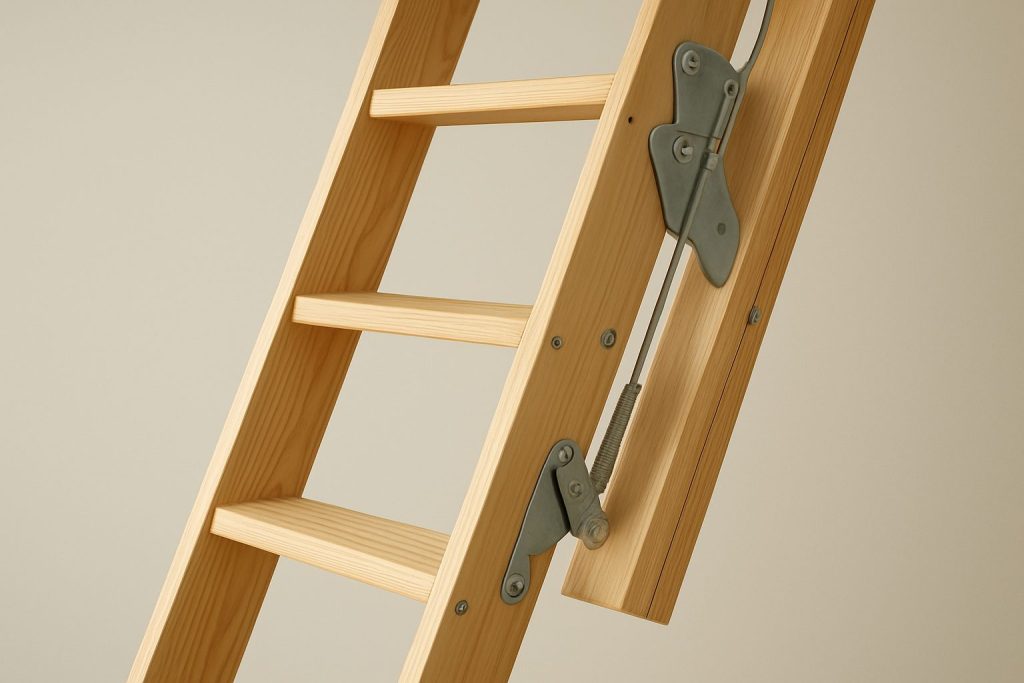
Most buyers focus on price. The ones who end up replacing their loft ladder within five years almost always made the same avoidable mistakes.
Mistake 1: Choosing Softwood Over Hardwood to Save Money
Pine and spruce cost less than beech or ash. That price gap makes softwood tempting—but in a loft environment subject to seasonal temperature changes, softwood expands and contracts more dramatically, increasing the risk of joint failure over time.
Hardwood wooden loft ladder options carry a higher upfront cost but deliver measurably better structural performance across the product’s lifespan.
Mistake 2: Ignoring Load Capacity Ratings
A ladder rated for 120kg may seem sufficient for most adults. But load ratings account for static weight, not dynamic force. Carrying boxes, tools, or furniture into the loft generates impact forces that can exceed the static limit significantly.
Standard recommendation: Select a model rated for at least 150kg, regardless of the user’s body weight.
Mistake 3: Skipping the Safety Standard Check
BS EN 14975:2006 is the European safety standard governing loft ladder design and performance. Not all products sold in the UK meet this standard. Purchasing a non-compliant ladder may also affect your home insurance coverage in the event of an accident.
Always verify compliance before purchasing—this information should appear clearly on the product listing or packaging.
Mistake 4: Buying the Wrong Size for the Hatch Opening
Standard UK hatch openings measure approximately 562mm x 726mm, but many older properties have non-standard dimensions. Installing a ladder into an incorrectly sized opening affects both safety and aesthetics.
Measure twice. Account for the frame thickness of the ladder unit as well as the clear opening of the hatch.
Mistake 5: Underestimating Installation Complexity
A wooden loft ladder typically weighs 20–35kg. Solo installation is possible but physically demanding, and misalignment during fitting creates long-term operational problems.
Key stat: Professional installation reduces the risk of hatch frame damage by approximately 60% compared to DIY fitting, according to installer feedback collected by the Federation of Master Builders (2022).
Mistake 6: Neglecting Post-Installation Maintenance
Wood is a living material that responds to its environment. Failing to apply a moisture-resistant treatment within the first year—and every 2–3 years thereafter—accelerates surface degradation.
A simple annual inspection and treatment routine adds minimal cost but can extend ladder lifespan by 10 or more years.
Mistake 7: Choosing Aesthetics Over Function
Wide treads, a natural finish, and a varnished handrail all look appealing in product photography. But if the folding mechanism is difficult to operate or the angle of pitch is too steep for comfortable use, the ladder will be avoided—or used unsafely.
Recommended tread depth: Minimum 80mm for comfortable foot placement. Recommended pitch angle: 60°–75° for standard residential use.
Frequently Asked Questions From First-Time Buyers
What is the best wood type for a loft ladder?
Beech and ash are the most commonly used hardwoods for loft ladders. Both offer high density, good resistance to surface wear, and reliable joint integrity.
Can I paint or stain a wooden loft ladder?
Yes. Most untreated and pre-primed models accept standard wood paint or stain. Use a product compatible with high-traffic surfaces and allow full cure time before use.
Is a wooden loft ladder suitable for a flat roof access hatch?
Standard residential loft ladders are designed for pitched roof loft access. Flat roof hatches typically require a different product category. Verify the product specification before purchasing.
How do I stop my wooden loft ladder from creaking?
Creaking is usually caused by dry joints or loose fixings. Apply a small amount of beeswax or furniture paste to the joint contact points and tighten all bolts to the manufacturer’s specification.
Are wooden loft ladders child-safe?
With proper supervision, yes. For households with young children, consider a model with a locking hatch mechanism to prevent unsupervised access.
You may also like
-
Trusted HVAC Services in Ventura County for Complete Home Comfort
-
Durable Bullnose Skirting Provides Seamless Floor Transitions
-
“Premium Windows in Coral Gables: Style and Energy Efficiency Combined”
-
What to Expect from Your Tuition Teacher
-
Do You Really Need to Byta tak (Replace the roof) Or Repair It?